
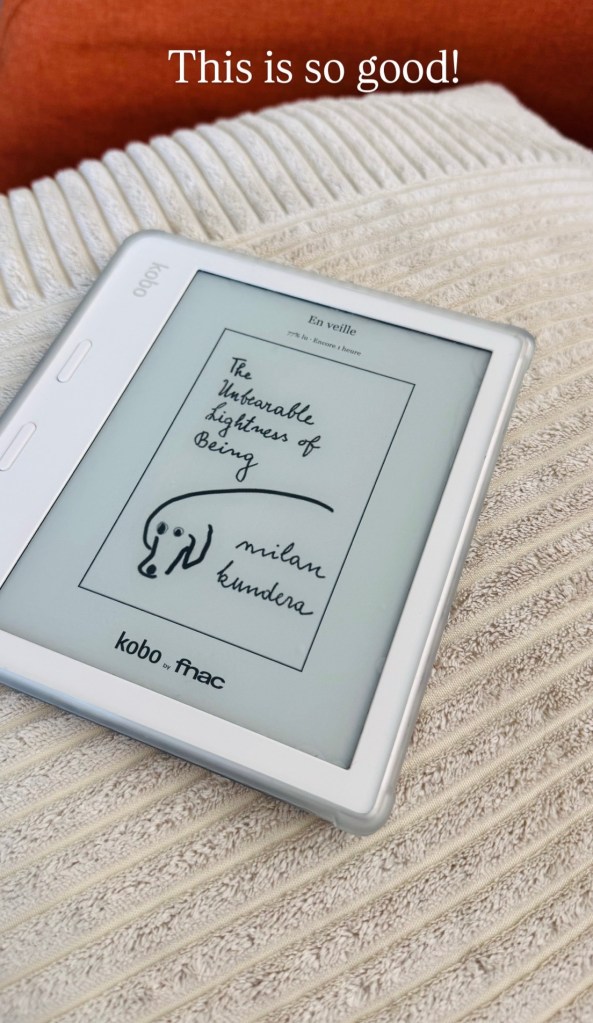
Tereza, Tomas, Sabina and Franz navigate life and love in postwar Europe (and US, a bit)

They experience Communism and soviet occupation, make life altering decisions and are plagued with existential questions, and meaning crises. Their entangled lives provide the meat for this novel-philosophical tale-romance-assay-psychoanalysis-satire.
“Can proximity cause vertigo?
It can. When the north pole comes so close as to touch the south pole, the earth disappears and man finds himself in a void that makes his head spin and beckons him to fall.
If rejection and privilege are one and the same, if there is no difference between the sublime and the paltry, if the Son of God can undergo judgment for shit, then human existence loses its dimensions and becomes unbearably light.”
Does life have a purpose, a meaning? Do our choices matter? Are the people we love an anchor or a stifling weight? Drawing on Nietzsche’s eternal return theory, Kundera examines the good old human quest for meaning through the lightness/heaviness dichotomy. Is an inconsequential life a freer one? When does the lightness and meaninglessness of life become unbearable? Is constant flight, perpetual betrayal the way to freedom, to happiness?
“Yes, it was too late, and Sabina knew she would leave Paris, move on, and on again, because were she to die here, they would cover her up with a stone, and in the mind of a woman for whom no place is home, the thought of an end to all flight is unbearable.”
These questions are explored through deliberately archetypical characters that live according to either lightness or heaviness, and the dilemma is never resolved. Should it, anyway? I feel like, as with many things in life, it is the tension between these opposite impulses that make life possible. We don’t, we can’t live in the stasis of absolute certainty, of total coherence.
“Tereza stood bewitched before the mirror, staring at her body as if it were alien to her, alien and yet assigned to her and no one else. She felt disgusted by it. It lacked the power to become the only body in Tomas’s life. It had disappointed and deceived her.
All that night she had had to inhale the aroma of another woman’s groin from his hair!”
Life is a quest, a perpetual balancing act. It’s the difference of potential between two poles that gives us the impetus, the energy to move forward. In this way, the resolution of all dilemmas may look like peace, but it is a deathly one. Even in the novel, these opposite are somewhat attracted to each other. It causes them pain yes, but it is also the motor of their life. It brings changes, agony and adventure. One must be uncomfortable to be moved to act.
“Suddenly, she longed to dismiss her body as one dismisses a servant : to stay with Tomas only as a soul and send her body into the world to behave as other female bodies behave with male bodies.”
These themes are explored through a very engaging voice, one infused with sardonic humour, where the most absurd anecdote can serve as the source of a profound lesson.
“Stalin’s son laid down his life for shit. But a death for shit is not a senseless death. The Germans who sacrificed their lives to expand their country’s territory to the east, the Russians who died to extend their country’s power to the west—yes, they died for something idiotic, and their deaths have no meaning or general validity. Amid the general idiocy of the war, the death of Stalin’s son stands out as the sole metaphysical death.”
The novel may appear a bit pessimistic. The final is not delivered neatly tied in the ribbon of resolution and happiness never-ending. Nor is there a tragic, heroic and grandiose end. In a way, these journeys that end on a whimper seem to confirm the unbearable lightness of it all. And yet. And yet each of these lives were filled with a whole universe of questions, rapture, trauma and loss. The drama was everything to those who lived it. And they left a mark, on others, even unwittingly. Think about the web of relationship we weave. One life among many, but every one matters. We are but links on a chain. Our lives are this tightrope between freedom and inconsequence, gravity and heaviness.
“When a private talk over a bottle of wine is broadcast on the ratio; what can it mean but that the world is turning into a concentration camp?”
” A concentration camp is the complete obliteration of privacy. “
The idea of a human being reduced to a cog in a machine is explored in a darker way through the soviet ruling of the country. Lives at the service of an ideology. But the control becomes an end in itself. Abolition of privacy coupled with the unpredictable nature of the almighty surveillance make people paranoid, they become their own jailer. Cowards. And cowardice is such a potent agent of totalitarianism. I have always been horrified but fascinated by these total societies, where even your most intimate thought may be put under a glaring spotlight. TULOB paints it strikingly. It made me think about our own “free” societies. Interestingly we willingly put ourselves under the spotlight today. Be it on social media or through handing off of our personal data to sloppy companies. And the consequences can be dire at so many levels…

But I digress. Let me just earnestly invite you to read this one, there is so much to ponder in there, you’ll find food for thought for a while.
Happy Reading,
Kémy
 Kemy's bookshelf